Sleep & Fibromyalgia
5 Ways Fibromyalgia Is Quietly Stealing Your Sleep, and the Simple Mattress Upgrade That's Finally Helping People Wake Up Without Dreading the Morning

For people living with fibromyalgia, the bedroom can feel like a place of dread rather than rest, and the mattress beneath them may be making it worse.
As Seen In
If you have fibromyalgia, you already know that sleep is not the simple, restful thing it is for most people. You go to bed exhausted, genuinely exhausted, and you wake up feeling like you barely closed your eyes. Your shoulders ache. Your hips feel bruised. Your lower back is stiff before your feet even touch the floor.
You tell yourself it will get better. You try a new pillow, a different position, a heating pad. But night after night, the same thing happens. You lie there, shifting every 20 minutes, trying to find some angle where the pressure does not feel unbearable, where your body can just… rest.
Here's what most people, and even some doctors, do not immediately connect: the surface you are sleeping on may be making your fibromyalgia symptoms significantly worse. Not your condition itself. The surface. And that is something you can actually do something about, without spending thousands on a new mattress.
Below are the 5 specific ways fibromyalgia disrupts sleep that most people do not fully understand, and why thousands of people with fibromyalgia are now turning to a simple mattress upgrade instead of anything else.

When fibromyalgia is present, the body's pain-processing system treats ordinary pressure as a genuine threat, making even a standard mattress feel punishing.
Fibromyalgia changes the way your central nervous system interprets sensation. What a healthy nervous system registers as mild pressure, the weight of your hip against a mattress, the push of a spring beneath your shoulder, your nervous system registers as pain. This is called central sensitization, and it is one of the core reasons fibromyalgia is so exhausting to live with.
When you lie on a mattress that is even slightly firm, those pressure points do not just feel uncomfortable. They ache. They burn. They pull you out of deep sleep, over and over, without you even realizing it is happening. You think you slept six hours. But your body was processing discomfort signals almost the entire time.
: Sandra, 61, fibromyalgia patient, Ohio
A mattress that does not distribute your body weight evenly will keep triggering those signals all night long. The pressure builds at your shoulders, your hips, your lower back, and your nervous system responds with tension, wakefulness, and pain that greets you before your alarm does.

Mattresses that sag or sit too firm concentrate body weight at vulnerable points, the exact areas where fibromyalgia pain clusters most.
Most people with fibromyalgia are sleeping on a mattress that is more than seven years old. Over time, mattresses lose their ability to respond to the contours of your body. Springs weaken. Foam compresses. What was once a supportive surface becomes a rigid platform that pushes back against you rather than cradling you.
For someone without fibromyalgia, that might mean waking up slightly stiff. For someone with fibromyalgia, it means waking up in real pain, hips aching, shoulders tender to the touch, lower back seizing up the moment you try to sit up. The mattress is not hurting you intentionally. It has simply stopped doing the job of distributing your body weight across a wide, even surface.
Buying a new mattress seems like the obvious fix. But here is the problem: new mattresses cost anywhere from $1,000 to $3,000, the return process is often complicated, and, as thousands of buyers have reported, a mattress that feels perfect in the showroom can feel completely different after a week at home. "It felt great in the store but horrible after a week" is one of the most common complaints in mattress reviews online. That is a very expensive risk to take when your sleep is already this fragile.
: Margaret, 58, fibromyalgia patient, Tennessee
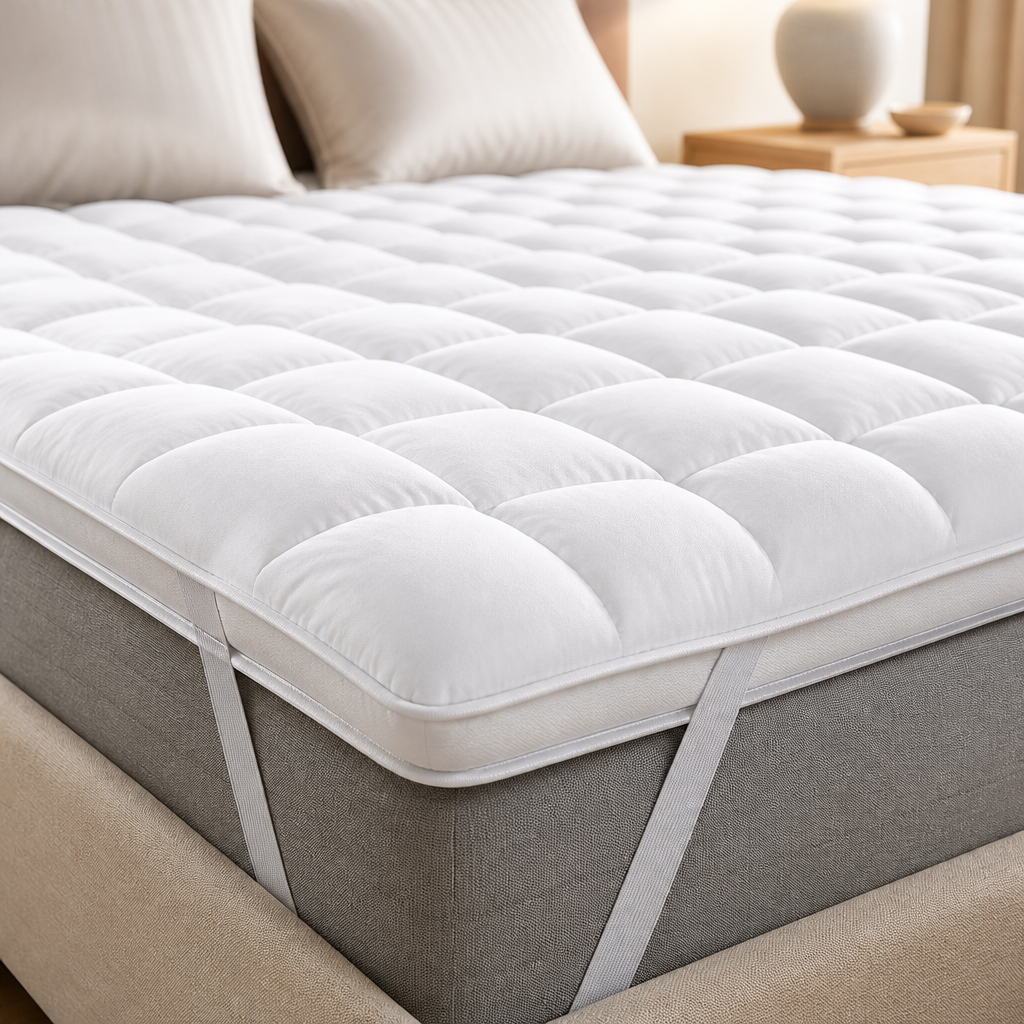
Standard foam toppers apply the same thickness across the entire body, meaning pressure-sensitive areas like hips and shoulders get the same treatment as areas that need less cushioning.
If you have tried a cheap mattress topper before and found it made little difference, you are not alone, and it is not your fault. Most inexpensive foam toppers are just a single flat layer of foam. They add some softness initially, but they compress quickly under body weight, especially at the heaviest contact points: the hips and shoulders. Within a few months, sometimes weeks, you are right back where you started.
What a person with fibromyalgia actually needs is not just softness. They need a sleep surface that responds differently to different parts of the body. Your hips sink differently than your shoulders. Your lower back needs different support than your legs. A flat layer of foam does not account for any of that. It simply sits there, compressing uniformly, leaving the areas that need the most pressure relief still bearing most of the load.
Pain medication is another common route. And while it has its place in fibromyalgia management, it does nothing for the underlying problem of pressure accumulating at tender points throughout the night. You wake up just as stiff. The pain is not addressed, it is briefly masked. That is not the same thing as restful, genuinely restorative sleep.

Each time pressure builds at a tender point, the body shifts, interrupting sleep cycles before deep, restorative rest can occur.
Here is what most people do not realize about fibromyalgia and sleep: the tossing and turning is not restlessness. It is your body trying to solve a pressure problem. When a shoulder or hip reaches a pressure threshold, your nervous system sends a signal, even if you are asleep, and your body shifts. This happens dozens of times a night without you ever fully waking up.
The result is a sleep pattern that looks like eight hours on a clock but functions like four hours in terms of recovery. You never spend enough time in deep sleep for your muscles to repair, for your pain sensitivity to reset, or for your mind to fully rest. You wake up in the morning feeling cheated, because, in a real sense, you were. Your body never got the time it needed.
Reducing the number of times your nervous system has to trigger that "move now" signal is one of the most meaningful things you can do for fibromyalgia sleep quality. And the most direct way to do that is to reduce the pressure that triggers those signals in the first place.
: Carol, 67, fibromyalgia patient, North Carolina

The stiffness many fibromyalgia sufferers feel upon waking is not random, it directly reflects the pressure points and restricted positions held throughout the night.
That stiffness you feel when you first wake up, the kind that makes you pause before you even attempt to stand, is not just fibromyalgia being fibromyalgia. It has a specific cause. When your sleep surface concentrates pressure at certain points rather than distributing it evenly, those areas experience reduced circulation and sustained muscular tension throughout the night. By morning, those muscles have been held in a guarded, compressed position for hours.
Think about how you feel after sitting in an uncomfortable chair for two hours. That tension in your back and hips is a minor version of what happens across your whole body during a night on a sleep surface that does not support you properly. Multiply that by eight hours, across every pressure point fibromyalgia makes sensitive, and you have a recipe for the kind of morning stiffness that does not ease for the first hour, or longer.
A sleep surface that supports spinal alignment and relieves pressure at the hips, shoulders, and lower back allows your body to rest in a more neutral position. The muscles around your joints do not have to work all night. Circulation stays more consistent. And the stiffness that greets you in the morning, while it may not disappear entirely, becomes measurably less severe. People with fibromyalgia who make this change consistently report that the first difference they notice is how they feel when they first get out of bed.
That's Why Thousands of People With Fibromyalgia Are Upgrading Their Sleep Surface, without Buying a New Mattress
After looking at all five of these problems, one thing becomes clear: the issue is not your mattress itself in most cases. The issue is the surface you are sleeping on, and specifically, whether that surface is soft and forgiving enough to stop concentrating pressure at the exact points where fibromyalgia makes you most sensitive.
You do not need to spend $2,000 to fix this. You need a sleep surface that creates a plush, pressure-distributing layer between you and whatever mattress you are already on. That is precisely what the OrthoBed Mattress Topper was designed to do.
OrthoBed was developed with input from sleep specialists and designed specifically for people who need more pressure relief than a standard mattress provides. It sits on top of your existing mattress and immediately transforms it into something softer, more forgiving, and more responsive to the shape of your body, all without any disruption to your bedroom and without the financial risk of mattress shopping.
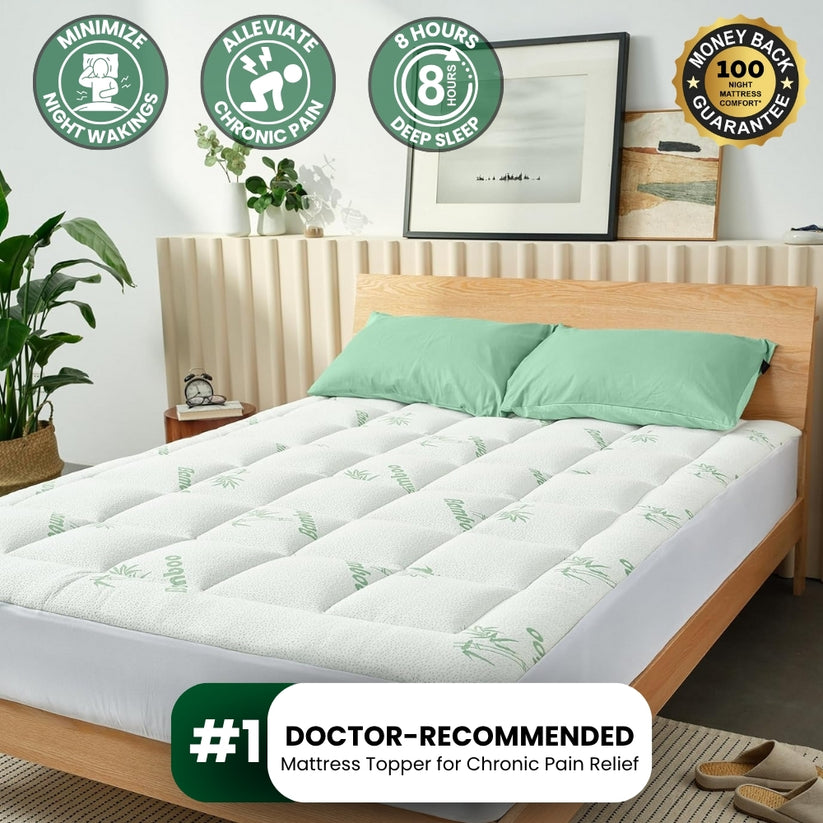
OrthoBed sits directly over your existing mattress, adding a plush, multi-zone comfort layer that responds to the shape and weight of your body.
What OrthoBed Does That a Flat Foam Topper Cannot
- Addresses pressure concentration at hips and shoulders, the areas fibromyalgia makes most sensitive (Problem #1 and #4)
- Transforms a firm or aging mattress into a softer, more pressure-forgiving surface without buying new (Problem #2)
- Multi-zone comfort layer distributes body weight evenly across the full sleep surface, not just in one spot (Problem #3)
- Reduces the micro-movements caused by pressure buildup, helping your body stay in deeper sleep longer (Problem #4)
- Supports spinal alignment and keeps joints in a more neutral position through the night, easing morning stiffness (Problem #5)
- High-density orthopedic foam base prevents the sagging and compression that cheaper toppers develop within weeks
- Breathable construction stays cooler than standard memory foam, no overheating throughout the night
- Anti-slip backing keeps the topper in place all night, no bunching, sliding, or rearranging in the morning
- Universal sizing fits all standard mattress sizes
- Backed by a 100-night sleep trial, if it does not help, return it without worry
How the OrthoBed Three-Layer System Works
What People With Fibromyalgia Are Saying After Using OrthoBed
I almost did not try this because I have been let down by so many things. I have had fibromyalgia for 11 years and I have tried about everything there is. A friend with fibromyalgia told me about OrthoBed and I figured, with the 100-night trial, what did I have to lose? The first week I noticed I was not waking up as much during the night. By week three, I was actually making it to 6am before the pain woke me up. My hips do not feel like I spent the night on concrete anymore. It is not a cure. But it is the best sleep change I have made in years.
I was skeptical. I have tried two other toppers and they both went flat within a couple of months. This one feels different, more substantial. More like what I imagine a really good hotel mattress feels like. The thing I noticed most in the first week was the morning stiffness. It is still there but it is maybe half of what it used to be. I do not spend the first 45 minutes of the day just waiting for my body to loosen up anymore. That alone is worth the price.
My doctor actually mentioned looking into a better sleep surface before I found this. I have fibromyalgia and arthritis both, so nights were just miserable. I was tossing and turning every half hour. Since I put OrthoBed on my bed, I am not moving around nearly as much. My husband said I seem to be sleeping much more still through the night. And I can tell because I actually wake up feeling like sleep did something. It is not a miracle. But it feels like sleeping on a cloud compared to what I had.
I kept putting off buying a new mattress because I could not face the cost and the uncertainty. I read too many stories about people spending $2,000 and still not sleeping well. OrthoBed was recommended to me in a fibromyalgia support group and I am genuinely glad I tried it. It went on in about 10 minutes, stayed in place all night (I was worried about that), and made a noticeable difference to my shoulder pain within the first week. I feel like I wake up now instead of just regaining consciousness.
Current stock is running low. Doctor-recommended, 100-night trial.
Only a small number of units remain at the current price.
✓ 100-Night Sleep Trial | ✓ Doctor-Recommended | ✓ Free Shipping